Artificial Intelligence (AI) is rapidly transforming the digital landscape, making its understanding crucial for SEO professionals and businesses. As we approach 2026, AI integration into search engine algorithms and marketing strategies will redefine content discovery, consumption, and optimization. This article explores AI’s revolutionary impact on SEO, highlighting unique challenges and opportunities, particularly focusing on Generative Engine Optimization (GEO) and Answer Engine Optimization (AIO).
Table of Contents
The AI Revolution in Search: A Paradigm Shift
Search is undergoing a profound transformation from keyword queries to sophisticated contextual understanding. AI enables search engines to interpret user intent with remarkable accuracy, delivering hyper-personalized results. This is particularly vital for multilingual markets like Switzerland, where precise understanding of nuanced queries across German, French, Italian, and English is paramount.
What is AI in the SEO Context?
In SEO, AI involves machine learning algorithms for rankings and natural language processing (NLP) models for content meaning. It signifies intelligent automation and predictive capabilities, helping search engines understand conceptual relationships, not just words. For businesses, this means crafting content that addresses the underlying intent behind queries, aligning with semantic search principles.
From Keywords to Context: The New SEO Imperative
Modern AI-influenced search algorithms prioritize context, relevance, and user experience. This shift, driven by advancements in deep learning, means search engines analyze vast data to assess content quality, user engagement, and source authority. This contextual understanding is crucial for effective SEO in 2026, demanding a holistic approach beyond superficial optimization.
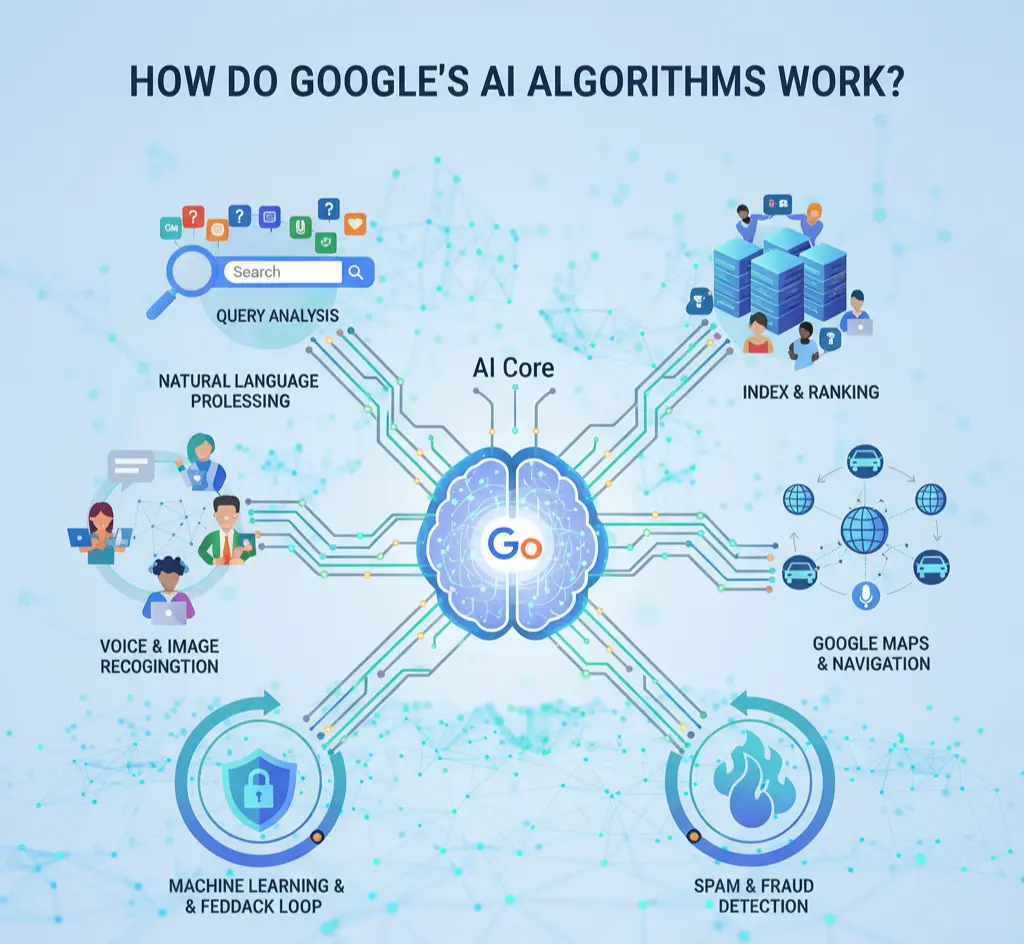
How Do Google's AI Algorithms Work?
Algorithm | Launch Year | Primary Function | SEO Implication |
|---|---|---|---|
RankBrain | 2015 | Interprets ambiguous search queries and user intent. | Emphasizes creating content that provides genuine answers and value. |
BERT | 2019 | Improved understanding of natural language nuances and context. | Requires optimizing for conversational and long-tail queries. |
MUM | 2021 | Multimodal and multilingual understanding across formats and languages. | Content must be optimized for a search engine that thinks and understands in a more human-like way. |
The Rise of GEO: Generative Engine Optimization

Generative Engine Optimization (GEO) is the practice of optimizing content to be easily consumed, summarized, and presented by AI-powered generative search experiences (like Google’s SGE or other AI chatbots). It is a critical component of future SEO strategy.
How Does AI Impact Local SEO and Hyper-Localization?
AI-driven personalization means the one-size-fits-all search engine results page (SERP) is becoming obsolete. Search engines tailor results based on a user’s behavior, location, and search history.
- Local Search Results: AI enhances the interpretation of local intent. For example, a search for “best coffee” will be hyper-localized based on the user’s precise location and past preferences, not just the nearest city.
- Google Business Profile (GBP) Optimization: AI models heavily rely on structured data and reviews from GBP. Ensuring your GBP is complete, accurate, and frequently updated is now a core GEO strategy.
- Multilingual Localization: In regions like Switzerland, GEO demands content that is not merely translated but culturally and linguistically localized to resonate with specific cantons and language groups (German, French, Italian).
Proactive GEO Strategy: AI predicts regional shifts in search demand, allowing businesses to optimize local listings and content in advance. This includes anticipating demand for specific services in different seasons or regions.
Mastering AIO: Answer Engine Optimization

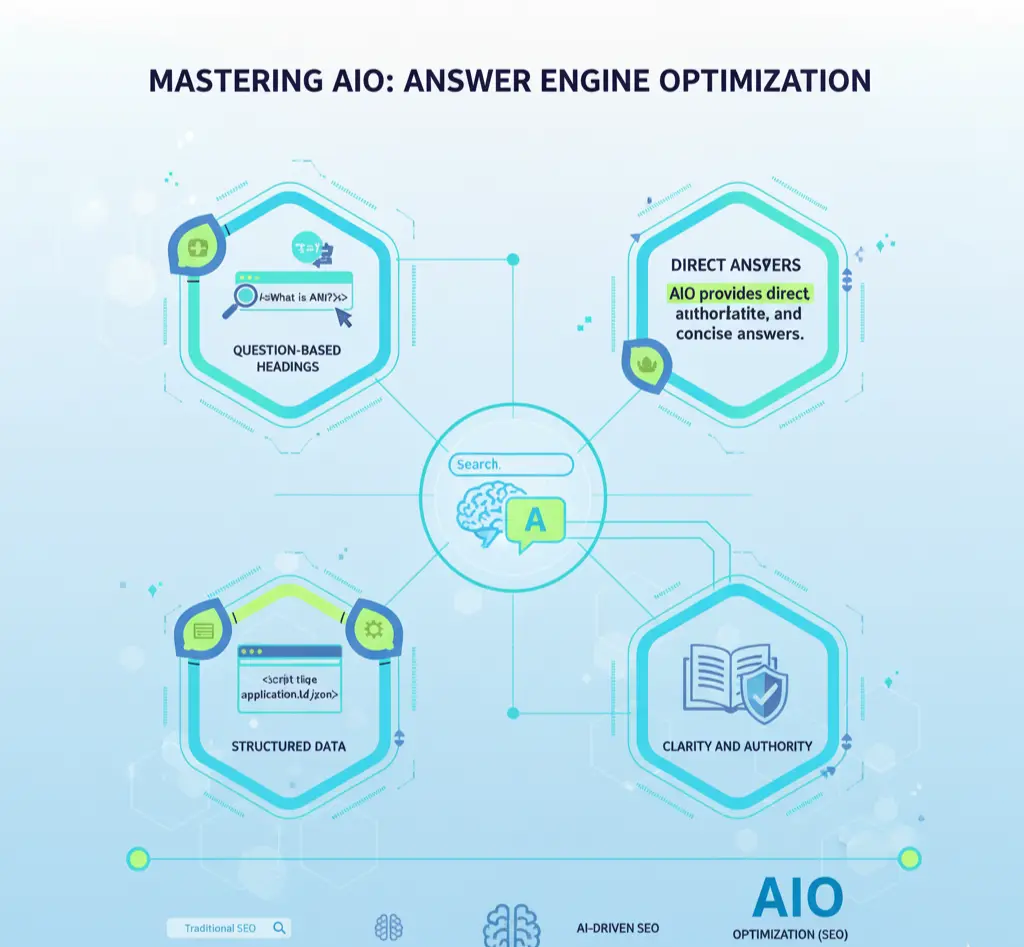
Answer Engine Optimization (AIO) is the strategic structuring of content to provide direct, authoritative, and concise answers that AI models and featured snippets can easily extract and use.
Key Principles for Effective AIO
To succeed in an AIO-driven world, content must be designed for clarity and extractability:
- Question-Based Headings: Use H2 and H3 tags to pose common user questions (e.g., “What is Generative Engine Optimization?”).
- Direct Answers: Immediately follow the question-heading with a concise, one-to-three sentence direct answer. This is the content most likely to be pulled into a featured snippet or AI summary.
- Structured Data: Implement relevant Schema Markup (e.g., FAQ, HowTo, LocalBusiness) to explicitly signal the nature of your content to AI models.
- Clarity and Authority: Ensure the answer is authoritative, well-supported by the surrounding text, and free of jargon.
AIO and Content Creation: AI tools can forecast common user questions, enabling direct, authoritative answers favored by AI models. The focus shifts to topical authority and semantic clusters, where content is comprehensive and addresses all facets of a user’s intent.
The Future is Collaborative: Human Expertise and AI

AI will not make SEO professionals obsolete. The future of SEO is collaborative, where human expertise is augmented and amplified by AI.
The Evolving Role of the SEO Professional
In an AI-driven world, SEO professionals shift from tactical execution to strategic oversight. They become conductors of an AI orchestra, guiding tools, interpreting data, and ensuring content aligns with human values. Creativity, critical thinking, and ethical judgment become more important than ever.
- AI-Assisted Content Creation: Generative AI models offer a huge opportunity to scale content production, especially for multilingual needs. However, human oversight is crucial for quality, accuracy, and brand consistency. The future lies in AI-assisted content, where human creativity is augmented, not replaced.
- Predictive Analytics: AI’s ability to analyze vast datasets and predict future trends allows for a proactive approach to SEO strategy, identifying new keyword opportunities and optimizing for emerging content formats.